Research Collaborations
Acorn's research program explores how hair follicle-derived cells and Secretome can support future applications in regenerative medicine, oncology, diabetes, cartilage repair, and neurodegenerative disease through collaborations with leading academic institutions.
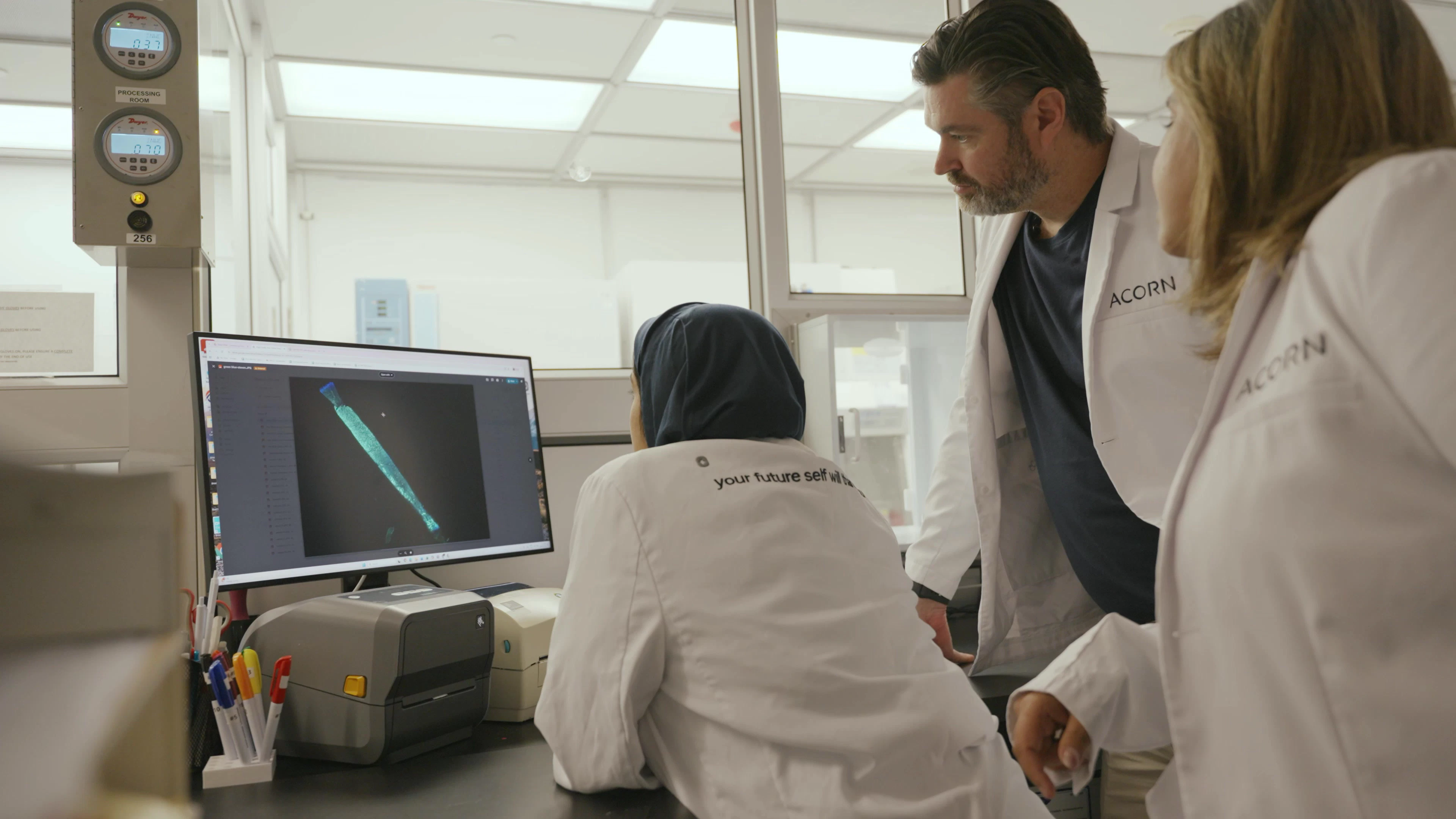
In Partnership with Leading Research Institutions





iPSCs · Diabetes
Hair follicle-derived cells as a high-quality source for iPSCs
Research conducted by Acorn Biolabs in collaboration with the University of Toronto (Rogers Lab) demonstrates that cells derived from human hair follicles can be reprogrammed into induced pluripotent stem cells (iPSCs). These iPSCs retain the capacity to differentiate into virtually any cell type in the human body, including pancreatic precursor cells—the functional cell populations lost in Type 1 diabetes.
Current phase:
Manuscript published.
Research Collaborator
Dr. Ian Rogers, PhD

NK Cells · Oncology
Hair follicle-derived iPSCs generate functional NK cells
Research by Acorn Biolabs, in collaboration with the National Research Council (NRC), has shown that induced pluripotent stem cells (iPSCs) generated from plucked hair follicles can be differentiated into natural killer (NK) cells capable of targeting specific cancer cell lines.
Current phase:
Manuscript in draft; Transition to animal modeling.
Research collaborator:
Dr. Anna Jezierski, PhD, MSc

MSCs · Cartilage Repair
Hair follicle-derived MSCs as a source for cartilage repair therapies
The study, in partnership with University of Calgary, demonstrates that mesenchymal stem cells (MSCs) isolated from plucked human hair follicles can be successfully cultured and expanded using serum-free, clinically applicable systems. These cells retain multipotent capacity and can be differentiated into osteocytes (bone), chondrocytes (cartilage), and adipocytes (fat).
In preclinical models, both the cells and their secreted factors (secretome) promoted significant cartilage regeneration in mice. Collectively, this work establishes hair-follicle-derived MSCs as a promising and accessible cell source for regenerative therapies targeting cartilage injury.
Current phase:
Manuscript in review.
Research collaborator:

Neurons · Parkinson’s Disease
Hair follicle-derived MSCs as a source for patient-specific neurons
Ongoing work by Acorn Biolabs, in partnership with the University of Guelph (Alpaugh Lab), is demonstrating that hair follicle–derived mesenchymal stem cells (MSCs) can be differentiated into functional dopaminergic neurons using established neuronal differentiation protocols.
This work highlights the potential of hair follicle–derived cells as a minimally invasive and scalable source of patient-specific neurons for future regenerative approaches targeting neurodegenerative diseases such as Parkinson's disease.
Current phase:
In-vitro work on going.
Research collaborator:
Dr. Melanie Alpaugh, PhD

Research Articles
2026, Peer-Reviewed Publication
Serum-Free Expanded Hair Follicle Mesenchymal Stem Cells Promote Cartilage Repair in a Murine Full-Thickness Defect Model
2026, Peer-Reviewed Publication
The Autologous Hair Follicle and Its Secretome: a Multipotent Source for Cell-Based and Cell-Free Regenerative Therapies
2024, Peer-Reviewed Publication
Efficient Generation of Pancreatic Progenitor Cells from Induced Pluripotent Stem Cells Derived from a Non-Invasive and Accessible Tissue Source — The Plucked Hair Follicle
2022, Review Article